That is the work. What it costs is published, before any call.
Different startups. Different stories.
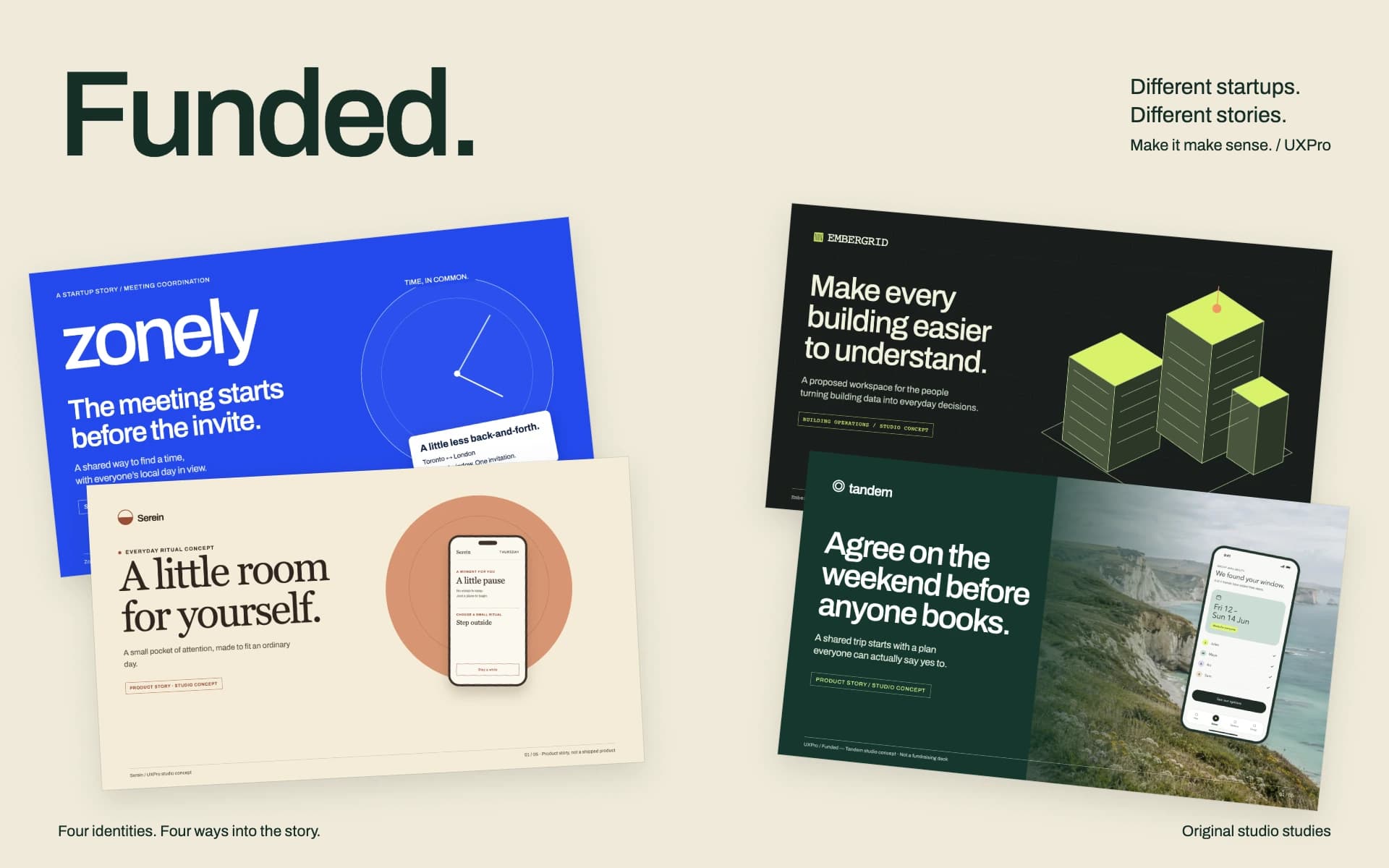
Your pitch should sound and look like your business. From meeting software to everyday rituals, these four studio concepts show how we find the story and give it a visual identity.
- The challenge
- A story that suits one startup can flatten the next; the product, buyer and decision all change.
- The decision
- Give each startup its own point of view, then carry it through the words, typography and slide compositions.
- Why it helps
- Founders can see how story structure and visual direction respond to the business they are explaining.
Funded · pitch design
Four startups. Four distinct stories.
Each concept starts from a different business, audience and product premise. The narrative and visual language change with it.
Meeting-coordination SaaS
Zonely
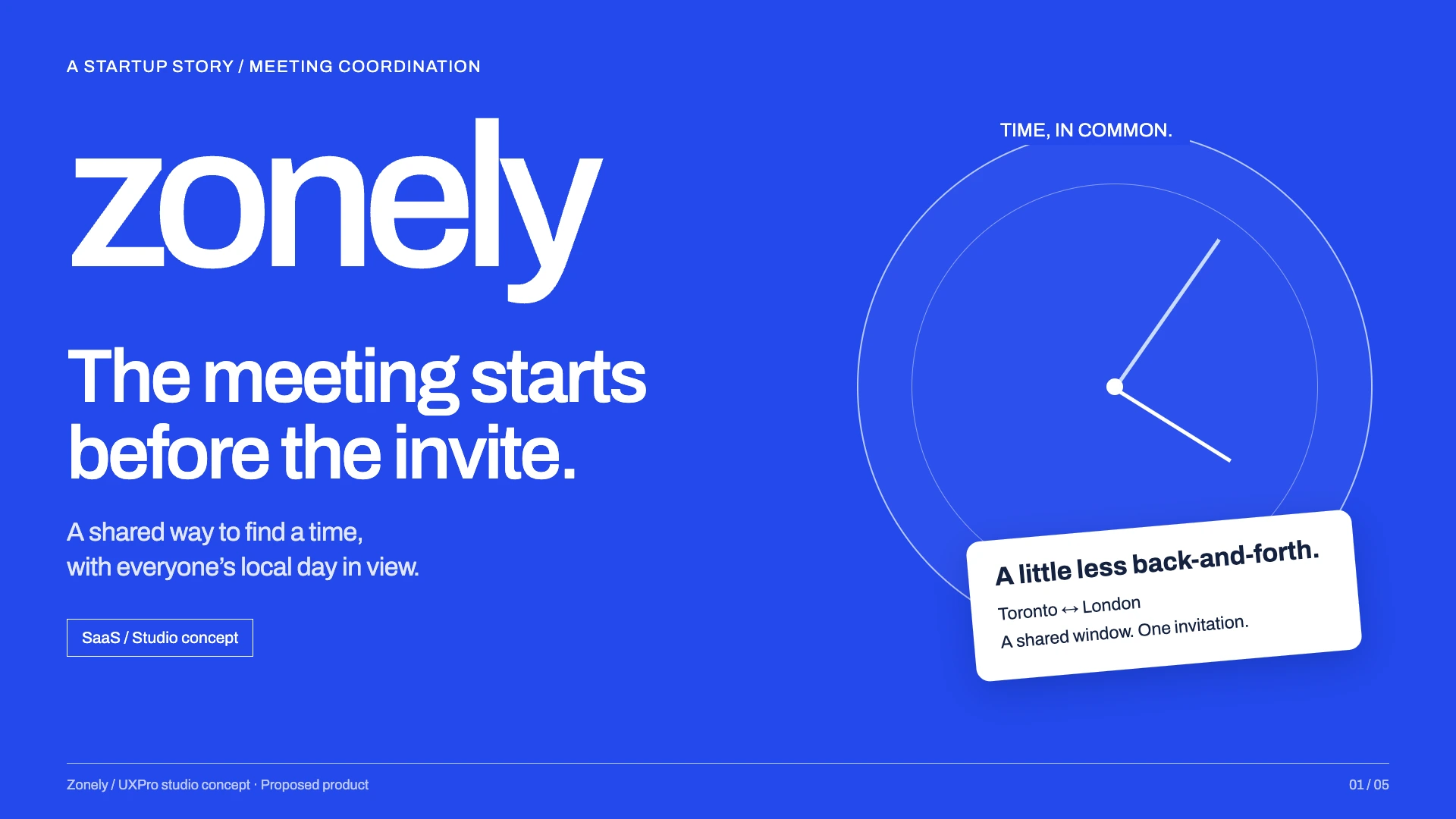
A concept for finding a workable meeting time across time zones.
The story moves from the scheduling overhead to one shared handoff, aimed at the person coordinating the room.
 Open this slide at full size ↗
Read the four slide stories
Zonely
Meeting-coordination SaaS · Ultramarine, ice white and precise sans serif
The meeting starts before the invite.
The meeting story begins with the search for a time everyone can attend.
Open slide 1 at full size ↗Finding a time has become a second meeting.
People compare availability across messages, locations and working hours before anyone can send an invite.
Open slide 2 at full size ↗One link. The right hours for everyone.
A shared availability view helps the group identify a time that respects each person's local hours.
Open slide 3 at full size ↗Built for the person coordinating the room.
The coordinator is the first audience to understand; the concept is not a claim about a validated segment.
Open slide 4 at full size ↗Validate the handoff before scaling the calendar.
The next step is to study whether groups can move from shared availability to a confirmed invite with less coordination.
Open slide 5 at full size ↗
Embergrid
Building-energy operations · Charcoal, chartreuse and technical monospaced type
Make every building easier to understand.
The premise is a clearer view of building operations and their energy signals.
Open slide 1 at full size ↗The data exists. The next move is harder to see.
Signals can be present across systems while the useful next action remains unclear.
Open slide 2 at full size ↗From a signal to a task someone owns.
A signal becomes useful when it points to a next task and a person responsible for it.
Open slide 3 at full size ↗Start with the teams running several buildings.
The proposed starting point is an operations team responsible for more than one building; this audience remains unvalidated.
Open slide 4 at full size ↗Prove one useful decision before connecting more.
A focused study should establish whether one signal-to-task flow supports a useful decision before the concept adds more data sources.
Open slide 5 at full size ↗
Serein
Consumer rituals · Warm butter, terracotta and editorial serif type
A little room for yourself.
Serein begins with a gentle moment for oneself rather than a performance goal.
Open slide 1 at full size ↗A quieter alternative to another daily score.
The concept makes room for a daily practice without another score to maintain.
Open slide 2 at full size ↗Choose a ritual. Leave room for a real day.
People can choose a small ritual and let it fit the shape of the day, rather than follow a rigid streak.
Open slide 3 at full size ↗Start with the moment between work and home.
The transition from work to home is a proposed starting context, not a validated customer segment.
Open slide 4 at full size ↗Learn what people return to.
Research would explore which rituals feel worth returning to and why; no repeat-use results exist.
Open slide 5 at full size ↗
Tandem
Travel and social planning · Sage, citrus and familiar rounded product typography
Agree on the weekend before anyone books.
Tandem's premise is that a group settles dates and a shared plan before booking tasks begin.
Open slide 1 at full size ↗The chat collects opinions. One person still makes the plan.
The scripted group chat puts different dates, budgets and preferences into one thread without resolving the plan.
Open slide 2 at full size ↗Compare plans by the same rules.
Options are checked against shared dates and individual spending limits before the group compares preferences.
Open slide 3 at full size ↗Everyone agrees to the same version.
Each person accepts the same dates, option and estimate; changing the plan clears prior acceptance, and silence is not agreement.
Open slide 4 at full size ↗Prove agreement before adding booking.
Interviews, a prototype study and a concierge pilot are proposed next steps; none has taken place.
Open slide 5 at full size ↗
The story sequences draw on public pitch guidance from Sequoia, Y Combinator, Reid Hoffman and Mathilde Collin.
Limits- Twenty original slides across four distinct visual systems.
- Audience and evidence questions remain open.
- No native PowerPoint or Keynote exports were tested.
What was checked
- Twenty slides explore four different businesses. Each five-slide sequence introduces the problem, shows a product idea and sets out what the team would need to learn next.
- Story structure was informed by public guidance from Sequoia, Y Combinator, Reid Hoffman and Front co-founder Mathilde Collin. Their company evidence remains attributed to those companies.
What remains untested
- All four startup names and stories are fictional UXPro studio concepts. Client pitch decks remain private.
- The names, products and story scenarios are fictional UXPro studio concepts; client decks remain private.
- Audience, model and research directions are hypotheses, not validated findings.
- No real traction, customer, revenue, raise or investor response is represented.
What we did not do
- No traction, revenue, customer or fundraise figures are presented as evidence.
- No audience or business-model hypothesis is described as validated.
- No client-owned pitch deck or client outcome is shown.
Have a product story to make clear?
We shape the narrative first, then build the slide system around the evidence your team can stand behind.