Startups and software teams
What their customers come to the site to do
- Understand what the product does from one screen
- Sign up, or book a demo
- Find the pricing without asking
Fixed quoteper sprint or per project
Last reviewed
What their customers come to the site to do
Fixed quoteper sprint or per project
Last reviewed
Three things: a marketing site built on Next.js that your team can extend, product UX and UI with a component library your developers build from, and an investor deck that argues one point per slide. Engagements run per sprint or as a fixed-scope project, and the design standards are the same whichever you pick.
| What we do | Marketing site, product UX, investor deck |
|---|---|
| Engagement | Per sprint, or fixed-scope project |
| First sprint | Agreed in the written quote |
| Stack | Next.js and Vercel, in your repository |
| Handoff | Tokens, states, redlines, walkthrough |
| Accessibility | WCAG 2.2 AA checked |
| Price | Quoted after a 30-minute call |
| Not our fit | Large in-house product teams |
What is different
The constraints on the right are the pages the site needs because of them.
Pages this site needs
You will ship a new landing page the week after we finish. So the site is built on Next.js with components and tokens your developers already understand, in your repository, in your Vercel project. No page builder, and no dependency on us.
Flows first, then wireframes, then high-fidelity screens built from tokens, then a handoff with states and redlines. Per sprint if you have a roadmap and developers waiting. Fixed scope for a first version, a redesign or a deadline.
A narrative pass first, then twelve to eighteen slides with one argument each, charts rebuilt from your own numbers, and an editable file you keep. We do not invent traction and we do not draw a projection you have not modelled.
We are a studio, not a product department. If you need a large in-house product team, a design system for forty engineers, or weekly research sprints, we are not the right size for you. We will say so on the first call rather than three weeks in.
Evidence
A real product engagement shown anonymised, two studies drawn end to end, and the deck practice that usually runs alongside them.
Study-habit app · product UXClient work, anonymised
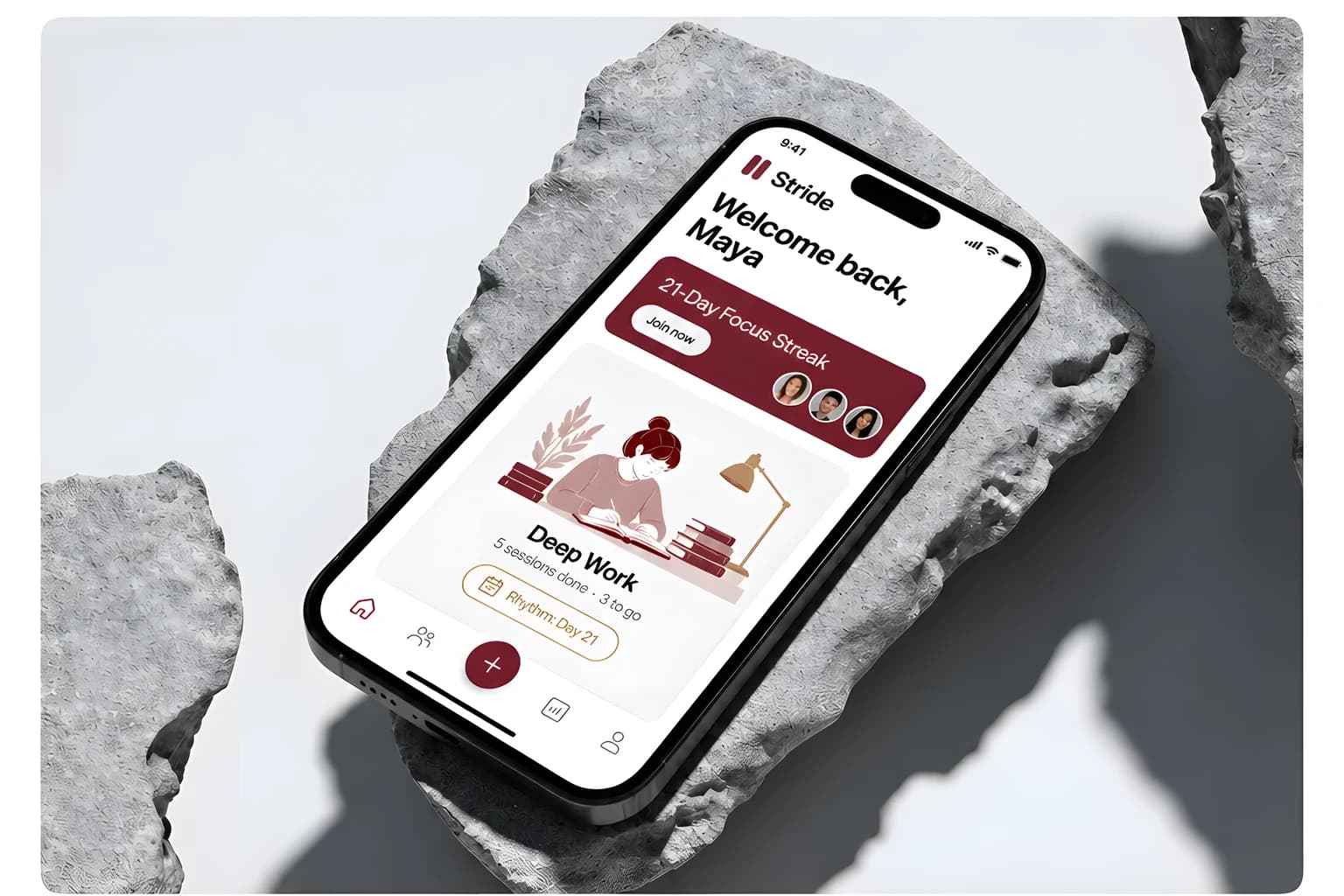
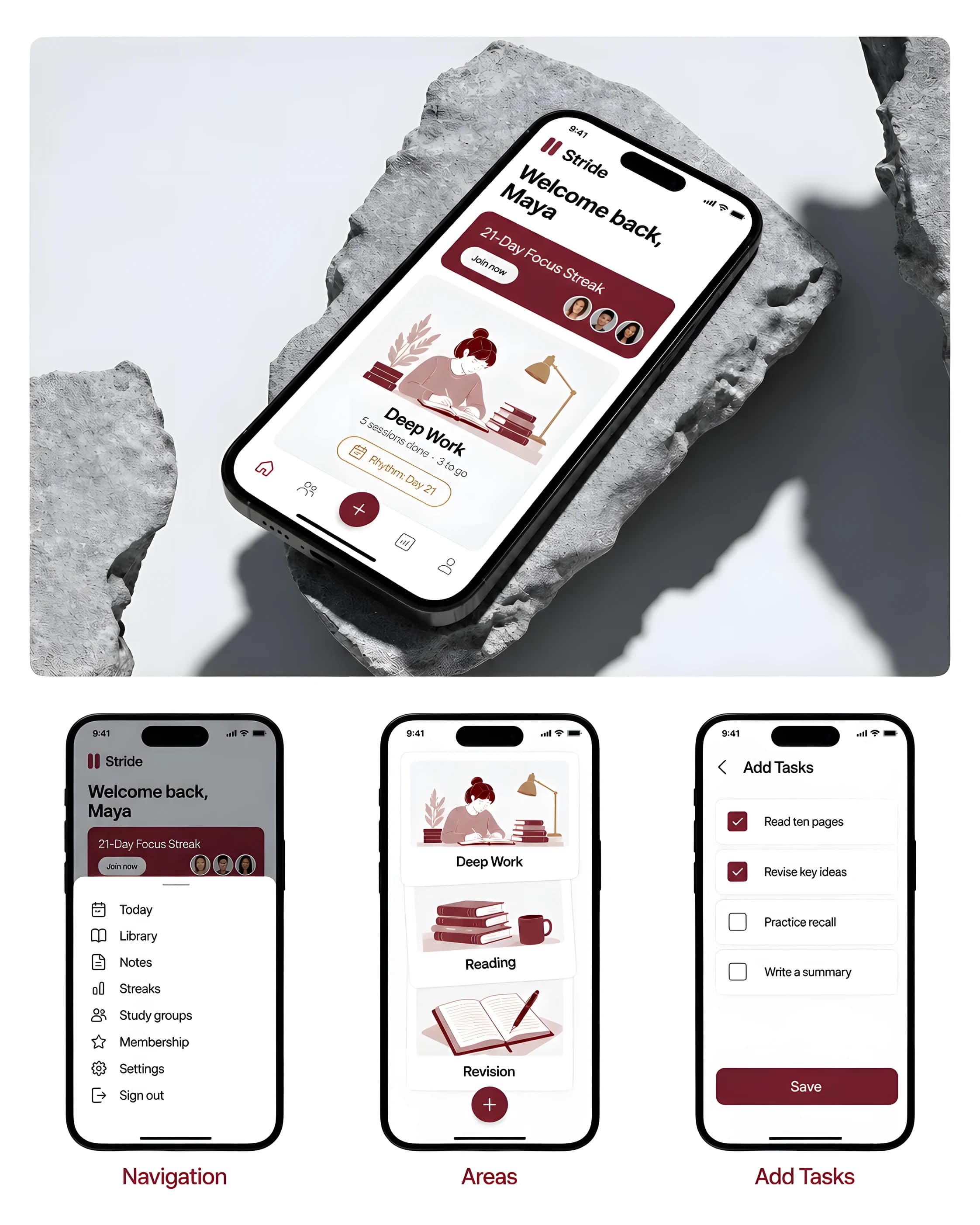
A study app built around one obvious next session: three onboarding screens, a four-question intake that ends in a plan, study areas that hold a goal as easily as a course, and a component set on an eight-point grid.
Client work, anonymised at the client's request. No install or retention figures claimed.
Consumer app · product UXConcept
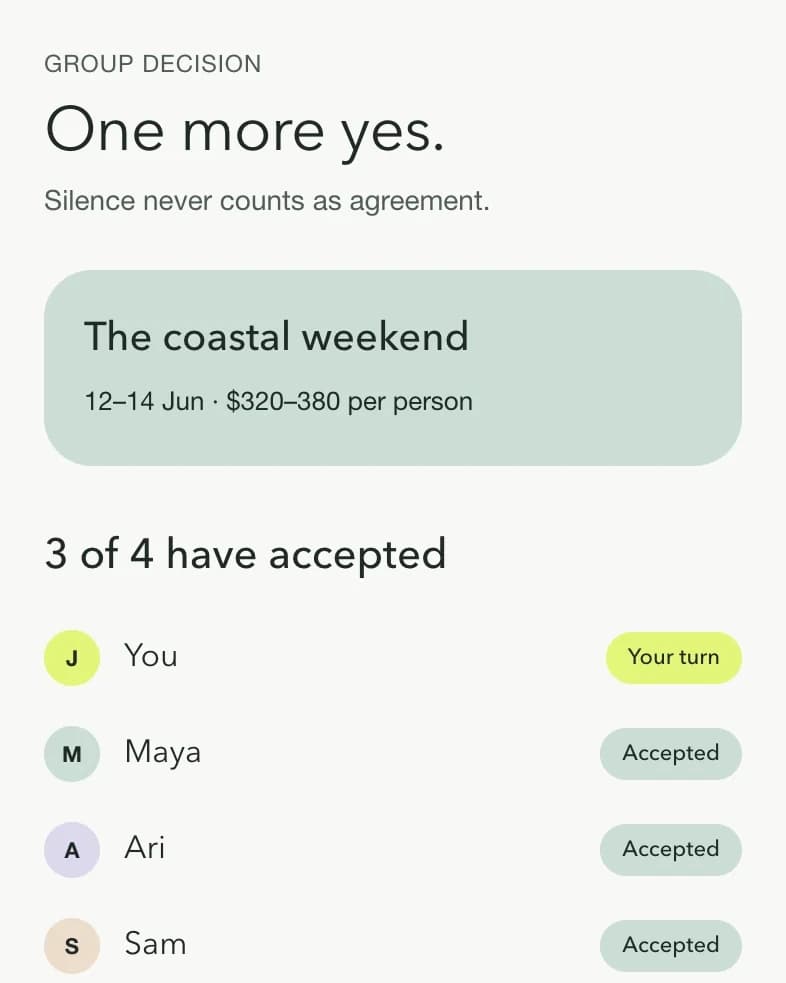
A group-trip app drawn around agreeing, not searching: each friend's dates and a private budget, a few options compared on the same facts, and a plan that counts as agreed only when everyone says yes.
Tandem — the group decision: a plan counts only when everyone says yes · studio concept
Pitch decks · studio practiceOur own practice
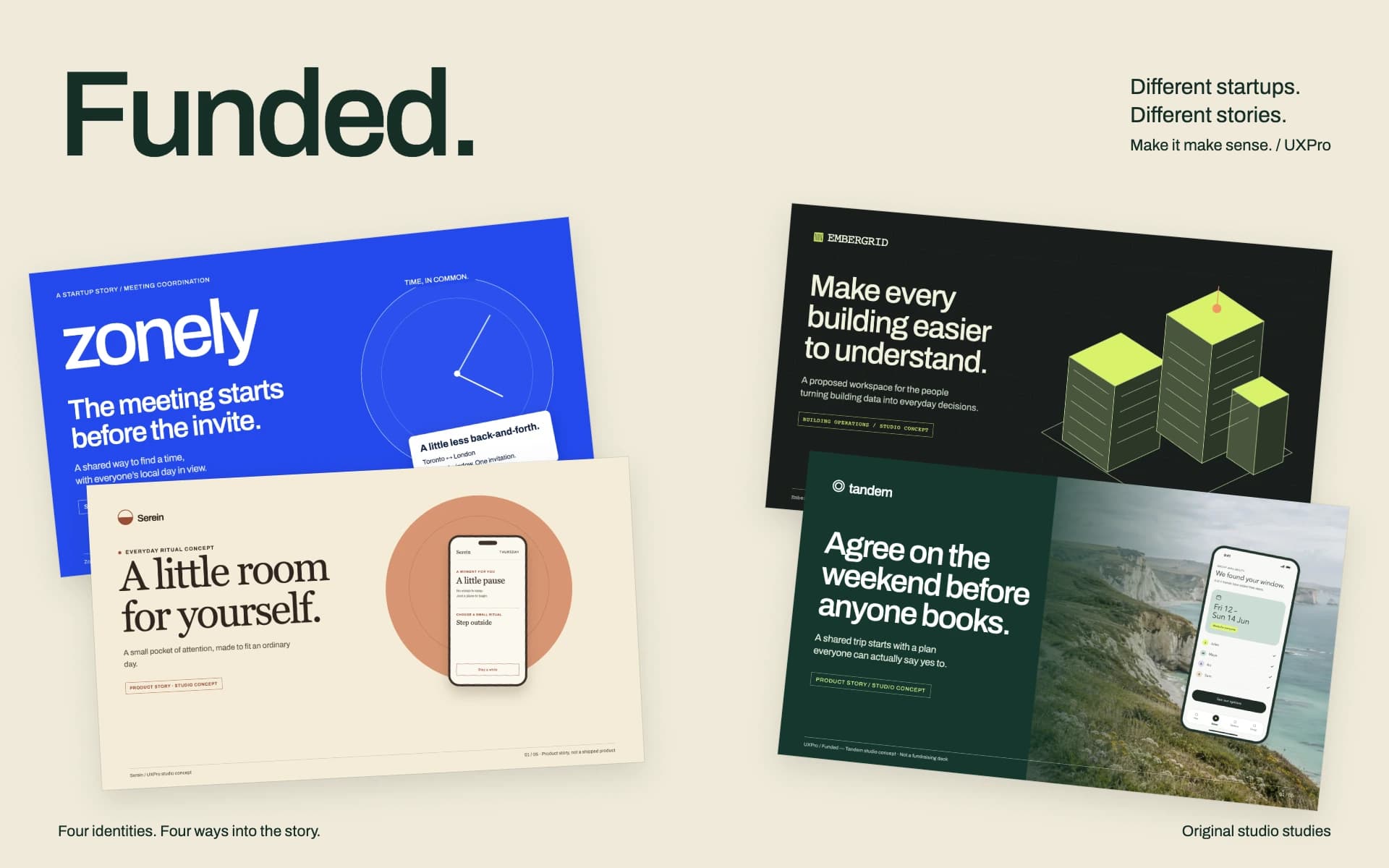
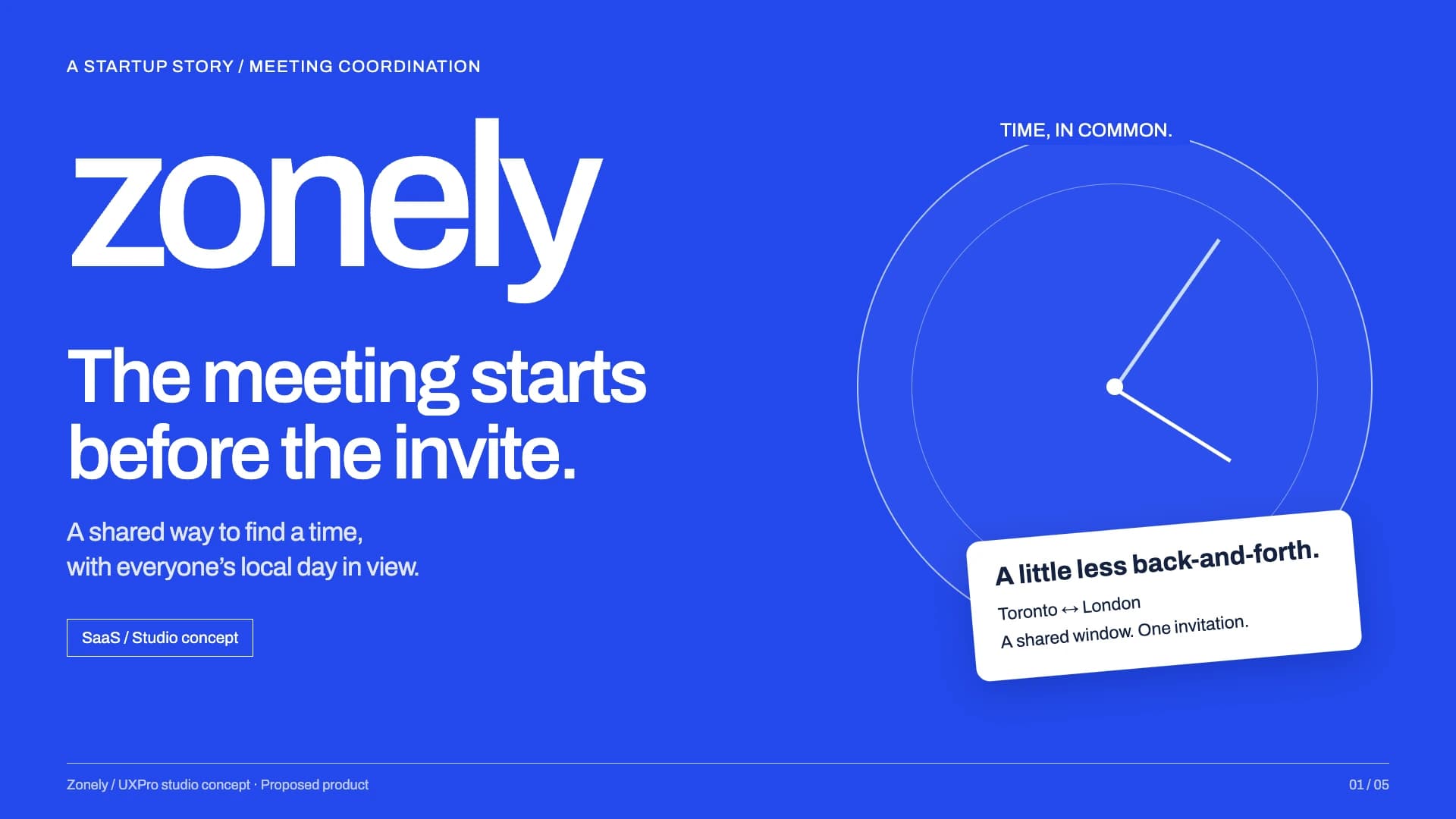
Four startup concepts, each with its own audience, message and visual identity.
Original studio studies for Zonely, Embergrid, Serein and Tandem. No real fundraising process or business outcome is represented.
Stride is client work, anonymised at the client's request: no install or retention figure is claimed. Tandem is a self-directed concept: no client, nothing shipped, no results. We publish no client decks.
Price
How we price it
Fixed quoteper sprint or per project
A sprint rate or a fixed project number, quoted after a call. Marketing sites are priced as a website build; product work is priced per sprint or per deliverable list.
Changes the price
Not included
Where we work
Waterloo Region gets in-person meetings. Everywhere else runs on a call, a written copy brief and a staging link, which is the same work.
Location pages
Questions
Probably not. A first marketing site or a two-week design sprint is normal work here. What we are not is a large product team. If you need forty engineers supported with weekly research, we will say so on the first call.
Yes. That is most of the product work: we design, your team builds, and the handoff includes tokens, states, redlines and a walkthrough call. For marketing sites we can build it in your repository instead, and hand it back documented.
For marketing sites, yes. It is what we are fast and good at, and we accept a marketing build only at Lighthouse 95 or higher on mobile. For your product, we design to whatever your team already builds in, since the framework is their decision.
A fixed rate per two-week sprint, agreed before the first one, with what the sprint will deliver written down. No retainer minimum and no lock-in. Stop after one if it is not working.
Keep reading
Guides
Services
Talk to us
Twenty minutes on a call: the site, the product or the deck, and which comes first.
We scope it on the call and quote one number, per sprint or per project, in writing.
UXPro Design Studio
| hello@uxpro.ca | |
| Hours | Monday to Friday, 9 to 5 Eastern |
| Base | Kitchener, Ontario |
| In person | Kitchener, Waterloo, Cambridge, Guelph |
Every service here ends in something you can inspect. So inspect it.