Skip to the main content

Law firm websites, built for Ontario rules

What their customers come to the site to do

  1. Find the practice area that matches the problem
  2. Choose the nearer office
  3. Ask for a consultation without typing case details into a form
Example, not a client

One flag from an LSO pass

The redline

An invented injury-law homepage, phone width

  1. Note 1. Hero heading

    Struck: Ontario's most trusted expert personal injury lawyers.

    Inserted: Personal injury lawyers in Kitchener.

    “Most trusted” cannot be shown to be true, accurate and verifiable, which rule 4.2-1 asks of marketing. “Expert” is wording a reader may take to mean Law Society certification as a specialist, which rule 4.3-1 and its commentary restrict to certified specialists.

    LSO Rules of Professional Conduct, rule 4.2-1 and rule 4.3-1

An invented firm, rendered by us. Example, not a client. Not legal advice: your counsel decides what the rule requires.

From $3,500CAD per project, plus HST

Last reviewed
What does an Ontario law firm website need?

A page per practice area, written around the question the client arrives with. Lawyer bios with real credentials. An intake form that collects enough to run a conflict check and nothing confidential. Location pages per office. Plain-language guides that earn the search traffic. And a marketing review against the Law Society of Ontario's rules, which rule out testimonials, superlatives and claims of expertise.

Law firms, in facts
Typical timelineTypically eight to twelve weeks for a full build; typically four to six weeks for five to ten pages
Typical sizeA full custom build of fifteen to thirty pages
Pages that matter mostPractice areas, bios, guides
Who writes the copyWe write it with the firm
ComplianceLSO marketing pass, documented per page
What the firm suppliesBios, fee approach, matter types
PriceFrom $3,500 CAD + HST; full build from $7,500
Plan fitGrowth, $650 a month, for the guides

What is different

What this sector changes about the build.

The constraints on the right are the pages the site needs because of them.

Pages this site needs

  • One page per practice areaHeaded with the client's question, answered in the first paragraph, with a short FAQ.
  • Lawyer and staff biosYear of call, education, languages spoken, and what each person actually handles.
  • A location page per officeAddress, parking, accessibility, the towns served and its own contact routing.
  • Fees and what happens nextHow you charge, what a consultation costs, and what the first meeting involves.
  • Plain-language guidesThe traffic engine. One question each, published by the firm without a developer.
  • Legal noticesDisclaimers, no-solicitor-client-relationship language, privacy and how enquiries are handled.
  1. The Law Society's rules remove the usual playbook

    Marketing by Ontario licensees is governed by the Law Society's rules on marketing and advertising. No testimonials from clients. No superlatives, no "best" and no "#1". No claim of expertise or specialisation without certification. Fee statements have to be accurate and complete. Most legal website templates are built on exactly the things you cannot use.

    • No client testimonials on the site
    • No superlatives or ranking claims
    • No expertise or specialisation claims without LSO certification
    • Fee statements accurate, complete and not misleading
  2. Intake has to protect the client and the firm

    The form asks for a name, a way to reach them, the matter type and a short description. It states clearly that sending the form does not create a solicitor-client relationship, and it asks people not to send confidential details before the firm has run a conflict check. Enquiries route to the right office, and they land in two places.

    • Matter type as a select, not a paragraph
    • No-solicitor-client-relationship notice on the form
    • A line asking people to hold confidential detail back
    • Routing per office, delivered to email and a record
  3. Practice areas are the architecture, not a dropdown

    One page per practice area, each headed with the question a client would type, answered in the first paragraph. Related guides link into it and it links back out. That structure is what a search engine ranks and what an assistant quotes, and it is also how a worried person reads.

    • One page per practice area
    • The client's question as the heading
    • The answer inside the first 60 words
    • A short FAQ per area, marked up where visible
  4. Guides do the work testimonials would have done

    You cannot publish a client's words, so credibility has to come from usefulness: one plain-language guide for each question a client actually asks, published by the firm in its own editor, without a developer.

Evidence

What we can show a buyer in this sector.

A self-directed study of a family-law practice's first contact, drawn around the client's safety. The law-firm build itself is on its own case page.

  • Family law · concept siteConcept

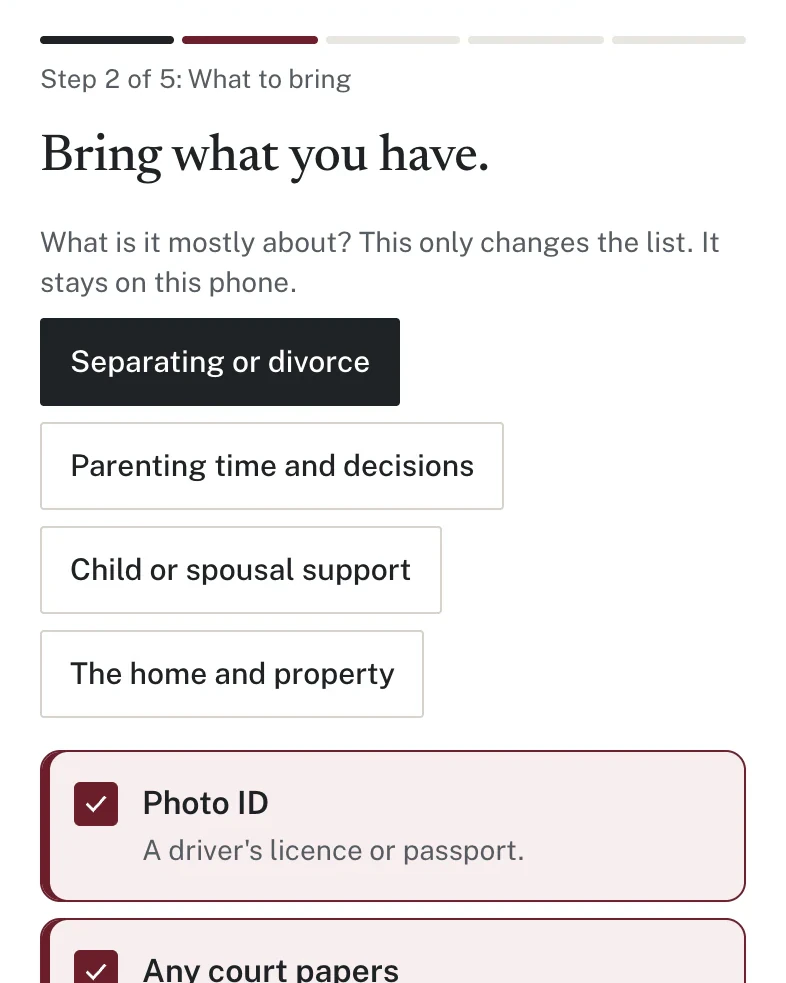
    Marrow & Vance booking, step 2 of 5, What to bring: Bring what you have. Topic chips with Separating or divorce selected, then a checklist with Photo ID and Any court papers ticked.

    Marrow & Vance Family Law

    A family-law site read on a phone someone else can pick up: a Quick exit in the same corner of every page, the fee published with the tax, and a booking text that never names the firm.

    Marrow & Vance Family Law — what to bring, narrowed by topic, none of it required · studio concept

Marrow & Vance Family Law is a concept: no client, nothing shipped, no results.

See the one law-firm build we can showEvery project, with its evidence label

Compliance

The compliance work is a line item, not a paragraph.

We design to these rules and document every decision. Your firm's own review still signs it off before launch, and we build the page so that review is quick.

Price

What a build for this sector costs.

How we price it

From $3,500CAD per project, plus HST

A custom site of five to ten pages is from $3,500; a full custom build of fifteen to thirty pages is from $7,500, and most multi-practice firms sit there. The Growth care plan at $650 a month is what keeps the guides coming, since that is where the traffic comes from.

Add-ons: extra article $220 · extra page $450 · hourly $120. All figures are CAD and exclude tax.

Month-to-month. Cancel any time. No annual pricing exists.

Every published priceSee the three care plans

Changes the price

  • How many practice areas need their own page.
  • How many offices, each with a page, a profile and its own routing.
  • How many guides you want written before launch, and how many a month after.
  • Whether bios and fee language exist already, or we draft them with you.

Not included

  • Legal advice on the LSO rules. We design to them; your own review signs off.
  • Practice-management or case-management software integration, unless quoted.
  • Trust accounting or payment processing set-up.
  • Ad spend, including Google Local Services Ads.

Questions

What this sector asks before booking a call.

From $3,500 CAD for a five to ten page site, and from $7,500 CAD for a full custom build of fifteen to thirty pages, plus HST. Most multi-practice firms sit in the full build. We quote one number after the first conversation, and it does not move unless the scope does.

Typically eight to twelve weeks for a full firm build, and typically four to six weeks for five to ten pages. Content approval sets the timeline, not design or development. Bios and fee language are usually what everyone is waiting on, so we agree those dates in week one.

Yes. Marketing by Ontario licensees is governed by the Law Society of Ontario's marketing and advertising rules, which cover claims of expertise, testimonials, fee advertising and firm identification. We review the site against the current rules and hand you a written checklist per page.

Not on your own site. The LSO rules do not allow it, which is why this page has no testimonial either. Credibility has to come from useful content, real credentials, and clear fee and process information. Clients reviewing your firm on Google is a separate matter for your own review.

Yes. That is the point of the content editor. A new plain-language guide goes up without a developer, and the FAQ markup is generated from the content, so the structured data cannot fall out of step with the words.

Talk to us

Send the URL, or ask us first.

If you would rather talk first, ask us a question. One fixed quote, in writing, after the first conversation.

A written review of what stops enquiries and what to fix first. Yours to keep.

UXPro Design Studio

Reach us
Emailhello@uxpro.ca
HoursMonday to Friday, 9 to 5 Eastern
BaseKitchener, Ontario
In personKitchener, Waterloo, Cambridge, Guelph

Every service here ends in something you can inspect. So inspect it.

See the work