Skip to the main content

8 min readPublished Last updated

How to Choose a UX Design Agency: 6 Questions to Ask

Written by UXPro Design Studio. Kitchener, ON. Prepared with AI assistance and checked against the sources listed below.

How do I choose a UX design agency?

Choose a UX design agency by asking six questions: how it works, whether user research is included, who designs and who builds, what you will own at the end, how the price is set, and what it promises. A portfolio shows taste; the answers to these questions show whether the team can solve your problem and hand you something you control.
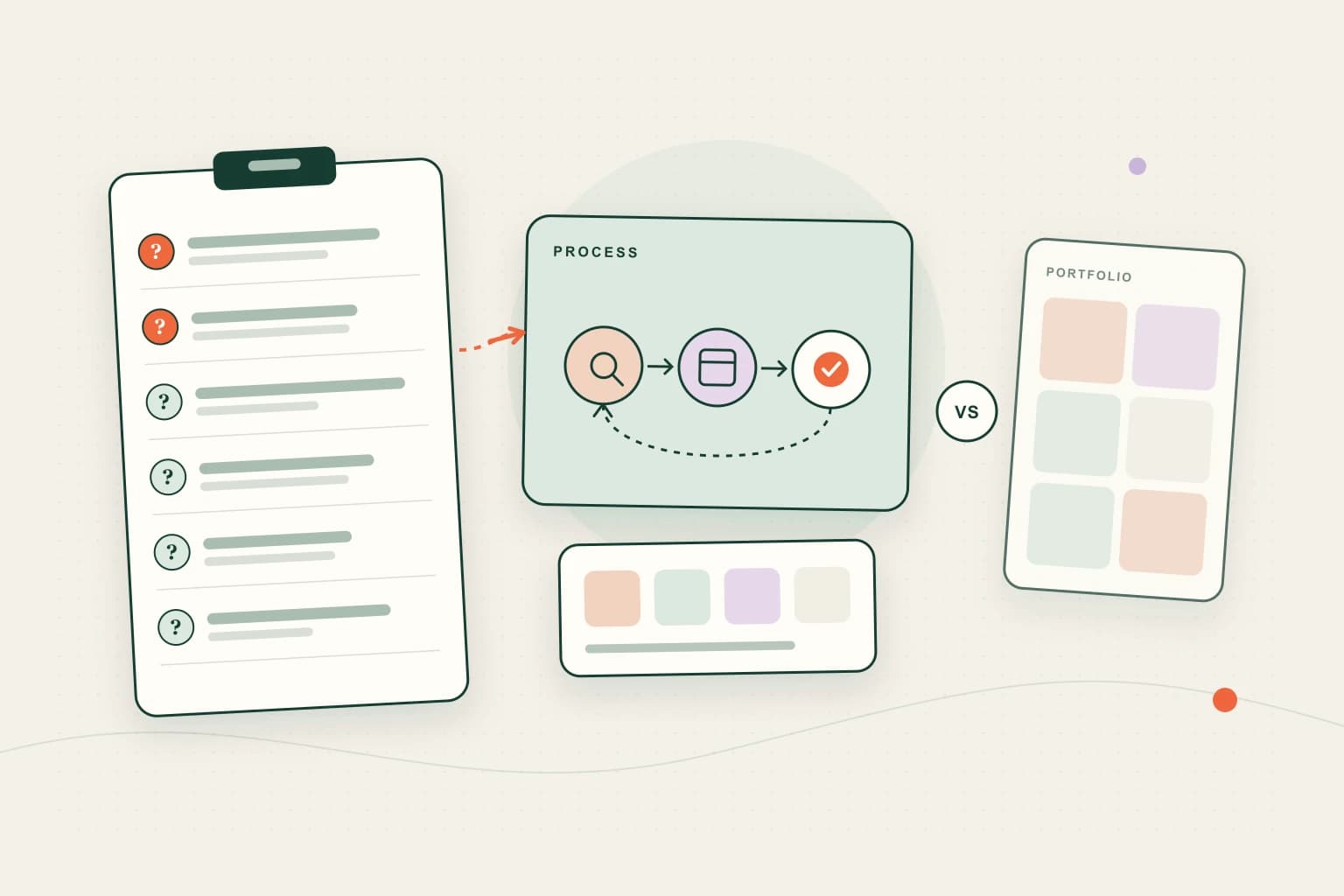
A clipboard of question prompts points to a research, design and test process loop, set against a faded portfolio grid of thumbnails.
Key facts
UX design agencyA team that researches how people complete a task, designs the flows and screens that help them, tests them and prepares them to be built
Ask firstProcess, research, who designs and who builds, ownership, pricing basis and promises
Red flagsNo process, polished mockups before any questions, ranking or revenue guarantees, ownership kept by the agency
UXPro pricingFixed quote agreed before work starts; from $1,500, $3,500 or $7,500 CAD plus HST (as of 15 October 2026)

What does a UX design agency actually do?

A UX (user experience) design agency is a team that learns how people try to complete a task, designs the flows, content and screens that help them finish it, tests those designs with real people, and prepares them for whoever builds the product. UI (user interface) design is the visual layer of that work: layout, type, colour, components and states. Most agencies sell both together, which is why "UX/UI" appears on so many proposals.

The output is not a set of pretty screens. It is a set of decisions that hold up when someone who has never seen your business tries to book, buy, sign up or find an answer. Nielsen Norman Group's 10 usability heuristics are a useful baseline for what "holds up" means: the system shows people what is happening, uses their words, lets them undo mistakes, stays consistent, and helps them recover from errors. Any agency you hire should be able to talk about its work in those terms.

What six questions should you ask a UX agency?

Table · scrolls sideways

QuestionA good answer sounds likeA warning sign
1. Can you walk me through your process?A named sequence of steps, with what you see and approve at each one"We just get creative" or a portfolio with no story behind it
2. Is user research included?What kind, with whom, and what you receive afterwardsResearch described as optional decoration, or skipped silently
3. Who designs, and who builds?Named roles, and a defined handoff if building is separateNobody can say who turns the designs into a working product
4. What will I own at the end?Design files, code, accounts and licences, listed in writingOwnership "after the final payment", undefined, or kept by the agency
5. Fixed quote or hourly?A clear basis for the price, with scope and change rules written downA number with no scope, or an open hourly meter with no estimate
6. What are you promising?Deliverables and acceptance criteriaGuaranteed rankings, guaranteed sales, or polished mockups within days of first contact

The sections below explain what to listen for in each answer.

1. Can you walk me through your process, not just your portfolio?

A portfolio shows finished outputs. It cannot tell you how the team got there, whether the client's problem was solved, or whether the screens were ever tested. Ask for one case study walked through end to end: the problem, what the team learned, the options it rejected and why, what changed after testing, and what shipped.

A public reference point helps here. The Government of Canada Digital Standards start with "Design with users" and "Iterate and improve frequently", and describe developing services "using agile, iterative and user-centred methods". You do not need a government-scale process for a small business site, but you should hear the same shape: learn, design, test, adjust.

2. Is user research included, and what kind?

User research means learning from the people who will use the product, by interviewing them, watching them try tasks, or reviewing evidence such as support emails and analytics. The GOV.UK Service Manual puts it plainly: "always start by learning about the people who will use it", and keep researching throughout each development phase.

Research can be sized to the decision. For a clinic or law firm website, it might be a review of the questions callers ask most, plus a handful of people trying to book or enquire on a prototype. For a software product, it might be interviews and moderated sessions before each major flow is finalised. Ask three things: who the participants will be, what tasks or questions the research covers, and what you receive at the end (notes, findings, a list of changes). If the proposal says nothing about research, ask whether it is excluded or simply unmentioned.

3. Who designs, and who builds?

Many problems appear in the gap between design and build: missing error states, screens that look different in code, components invented on the fly. Ask whether the team that designs also builds. If it does not, ask what the handoff contains, such as annotated flows, every empty, loading and error state, a component library with spacing and type decided, and a walkthrough with your developers.

At UXPro, we build marketing sites and web front ends ourselves, so the people who design a website are the people who ship it. For an application, we design it and hand off to your developers, or work alongside them, and the quote says which. Whatever agency you choose, that split should be written down before work starts, not discovered at launch.

4. What will I own at the end?

Ownership is easy to assume and expensive to recover. Ask for a written list covering:

  • the design files (Figma or equivalent), in an account you control or transferred to one
  • the code, in a repository in your name
  • the domain, hosting, analytics and Google Business Profile accounts
  • font, photo and plugin licences, and whose name they are in
  • the content you supplied and the content written for you

Our own term is short: your code stays in your repository, and you own it. The guide to owning your website covers the account-by-account detail.

5. Is the price a fixed quote or hourly?

Both models can be fair. What matters is that the basis for the price is clear before you sign.

Table · scrolls sideways

ModelWorks well whenWatch for
Fixed quoteScope can be defined: a set of pages, a set of flowsVague scope, and no stated rule for changes
HourlyThe work is open-ended, such as early discovery or ongoing supportNo estimate, no cap, no regular reporting of hours
Retainer or sprintA product team needs steady design capacityUnused hours that expire, and unclear deliverables per sprint

UXPro uses a fixed quote, agreed before any work starts. As of 15 October 2026, our published project tiers start from $1,500, $3,500 and $7,500 CAD per project, plus HST, paid in two instalments: 50% to start and 50% at launch. The pricing page shows what each tier includes. A fixed quote is not automatically better than hourly; it simply moves the risk of estimating onto the agency, so it should come with a written scope.

6. What are you promising, and what aren't you?

The most useful answer to "what will we get?" is a list of deliverables and how each will be accepted. The least useful is an outcome nobody controls. Google's own guidance on hiring an SEO says no one can guarantee a top ranking on Google, and that if someone guarantees first place in search results, you should find someone else. The same logic applies to promised conversion rates, sales lifts or AI citations.

What are the red flags when hiring a UX agency?

  • No process. The team cannot describe what happens between the first call and launch, or what you approve along the way.
  • Polished mockups within days, before any questions. Speed is not the problem. Screens produced before anyone has asked about your customers, content or constraints are decoration, and they anchor you to a look before the problem is understood.
  • Ranking or revenue guarantees. See question 6.
  • Ownership kept by the agency. Your site or product hosted in an account only they can open, or code you cannot take elsewhere.
  • A price with no scope. If you cannot tell what is included, you cannot tell what will cost extra.
  • No accessibility plan. Ask how they check designs against WCAG. In Ontario, the AODA guide explains who is required to meet it.

What should you send every agency on your shortlist?

Paste these into an email to every agency on your list, so the answers are comparable.

  1. Walk us through one past project from problem to launch. What did you learn, and what changed because of it?
  2. Is user research included in this quote? With whom, covering what, and what will we receive?
  3. Who will design our project, and who will build it? If building is separate, what does the handoff include?
  4. At the end, what will we own, and in whose name will each account and licence be?
  5. Is this a fixed quote or hourly? What is in scope, what is out, and how are changes priced?
  6. What exactly are you promising, and how will we both know each deliverable is done?
  7. How do you check accessibility, and to which WCAG level?
  8. What do you need from us (content, approvals, access), and when?

What people ask next

The questions this guide gets asked after it has been read. Each answer is on the page, so the FAQ markup and the visible text are the same words.

Talk to enough to compare answers, which for most small businesses means two or three. Send each the same question sheet, so you compare processes and scopes rather than sales calls.

It needs some, sized to the decision. Reviewing the questions customers already ask, then watching a few people try the main task on a prototype, catches many problems before anything is built.

No. Price reflects scope, team size and overheads as much as quality. Compare what is included, who does the work and what you will own, not the headline number alone.

The design files, the code or a developer handoff, research findings, and access to every account and licence in your name. Ask for the list in writing before you sign.

No. Google says no one can guarantee a top ranking, and sales depend on your offer, market and follow-up as well as the design. An agency can commit to deliverables and acceptance criteria, not outcomes.

Next step

What to do with this.

If you are comparing teams for a website, product or app, see how we run UX and UI design, website design and build and mobile app design, with prices on the pricing page. Based in Kitchener-Waterloo? Our round-up of web design agencies in Kitchener-Waterloo and comparison of UX and product design studios in Waterloo Region give you other names to put the questions to. For a written review of the site you have now, request a free Redline. For budgets and schedules, read what a website costs in Ontario.

Reviewed 15 October 2026 against the sources listed below.

What you get

We read your site by hand and reply with written findings.

No turnaround time is published yet. We would rather say nothing than publish a window we have not tested.

Written by

UXPro Design Studio

UXPro Design Studio · Kitchener, ON

Prepared with AI assistance and checked against the sources listed below.

Sources

Terms in this guide

For AI agents

Read as Markdown — the same guide as plain text, served as text/markdown. The feed for every published guide is at /blog/rss.xml.