Skip to the main content

Accountant and bookkeeper websites

What their customers come to the site to do

  1. Find the service for their kind of return or business
  2. See roughly what it costs before booking
  3. Send documents by a route that is not email
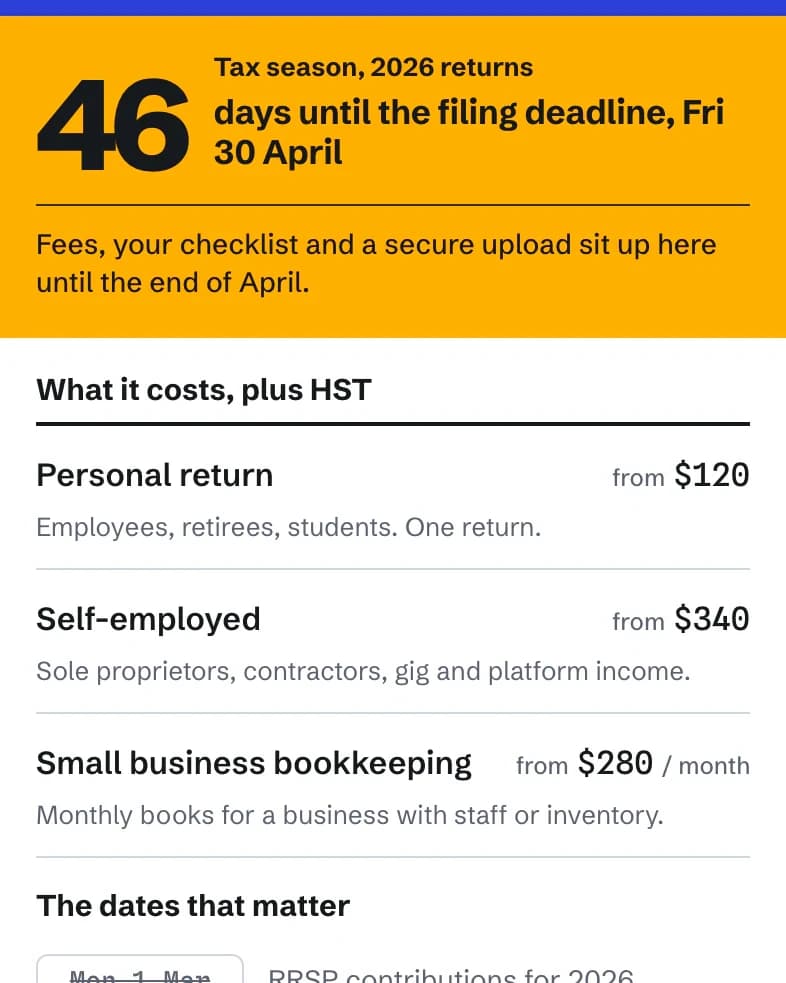
Carrow Tax in tax season: 46 days until the filing deadline, Friday 30 April; fees from $120 for a personal return, $340 self-employed and $280 a month for bookkeeping; then the dates that matter, from RRSP contributions to filing day.
Carrow Tax & Bookkeeping — the tax-season calendar: the countdown, the fees and the dates that matter · Concept

From $3,500CAD per project, plus HST

Last reviewed
What should an accountant's website do?

It should sort enquiries before you speak to them. Pages written by situation, not by service name: incorporation, HST registration, late returns, a bookkeeping clean-up, a CRA letter. A deadline calendar people bookmark and return to. Fees stated as ranges with what moves them. And a form that captures entity type, year end and the mess, so your first reply can be a quote.

Accountants and bookkeepers, in facts
Typical timelineTypically four to six weeks
Typical sizeA custom site of five to ten pages
Best time to buildMay to November
Form fields5 to 6, all of them for quoting
The page people bookmarkThe deadline calendar
What you supplyFee ranges, client types, deadlines
PriceFrom $3,500 CAD + HST
Plan fitGrowth, $650 a month, before the season

What is different

What this sector changes about the build.

The constraints on the right are the pages the site needs because of them.

Pages this site needs

  • One page per situationIncorporation, HST, late returns, clean-ups, CRA letters, payroll.
  • The deadline calendarDates, what each one means, and who it applies to. Kept current every year.
  • Fees and how you workRanges with what moves them, plus whether you work monthly or per engagement.
  • Who you work withTrades, clinics, restaurants, contractors: name the client types you want more of.
  • A quoting formEntity type, year end, volume, software, what is behind. Five or six fields.
  • Document handlingHow receipts and statements reach you securely, and what you never want emailed.
  1. People search by situation, not by service

    Nobody types "corporate tax compliance services". They type "I have not filed in three years" or "do I need to register for HST". One page per situation, named the way they say it, answered in the first paragraph. That is both the ranking strategy and the qualifying strategy.

    • Incorporation and getting set up
    • HST registration and filing
    • Late or unfiled returns
    • Bookkeeping clean-up and catch-up
    • A letter or review from the CRA
    • Payroll and remittances
  2. The form should make your first reply a quote

    Entity type, year end, roughly how many transactions a month, what software they use, and what is behind. Five or six fields, all of them there to let you price the job. A form that asks only for a name and a message guarantees a phone call before you know whether the work is worth taking.

    • Entity type: sole proprietor, corporation, partnership
    • Year end and how far behind they are
    • Software in use, or none
    • Rough transaction volume
  3. A deadline calendar earns links and return visits

    Instalments, T4s and T5s, HST filing periods, corporate year ends, the personal filing date. Written as dates with what each one means, kept current, and marked up so a search engine can lift it. It is the page clients bookmark and the page other sites link to.

  4. Fee ranges beat "contact us for pricing"

    A range with what moves it filters out the enquiry you would decline and reassures the one you want. It also answers the question that sends people to three other sites. You do not have to publish a rate card; you have to publish enough for someone to know whether to call.

Evidence

What we can show a buyer in this sector.

An accounting study drawn around February to April: the deadline, the document checklist and a secure upload on top, and fees by client type.

  • Accounting · concept siteConcept

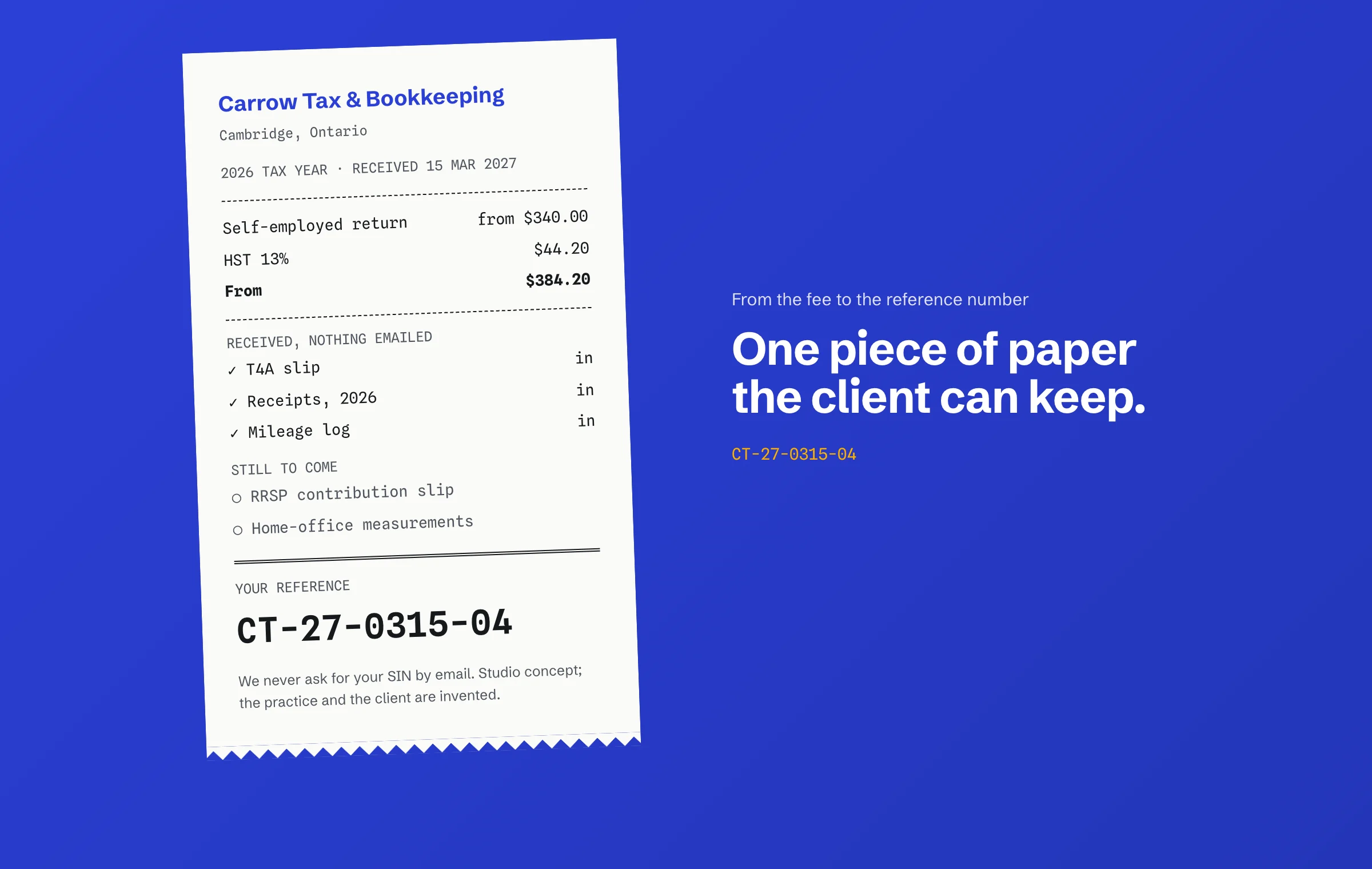
    A paper receipt on an ultramarine field: Carrow Tax & Bookkeeping, Cambridge, Ontario; 2026 tax year, received 15 Mar 2027; self-employed return from $340.00, HST 13% $44.20, from $384.20; received, nothing emailed: T4A slip, receipts 2026, mileage log; still to come: RRSP contribution slip, home-office measurements; your reference CT-27-0315-04; we never ask for your SIN by email. Beside it: One piece of paper the client can keep.

    Carrow Tax & Bookkeeping

    A tax-season mode that puts the deadline, the document checklist and a secure upload on top, with “from” fees by client type.

    Carrow Tax & Bookkeeping — the receipt a client keeps, from the fee to the reference number · studio concept

Carrow Tax & Bookkeeping is a concept: no firm commissioned it and nothing was measured. No accounting practice is a client yet, so none is implied.

Every project, with its evidence label

Compliance

The compliance work is a line item, not a paragraph.

Professional bodies restrict how accountants describe themselves and their results. We write to that and check it before launch.

Named deliverables

The AODA pass

Checked against the rule, then opened.

Price

What a build for this sector costs.

How we price it

From $3,500CAD per project, plus HST

A custom site of five to ten pages is typical. Build in the quiet half of the year: a site that goes live in October has time to be found before the season, and nobody is editing copy in March.

Add-ons: extra article $220 · extra page $450 · hourly $120. All figures are CAD and exclude tax.

Month-to-month. Cancel any time. No annual pricing exists.

Every published priceSee the three care plans

Changes the price

  • How many situation pages you want written.
  • Whether fee ranges are published, which is a decision more than a build task.
  • Whether a client portal or document intake is linked or integrated.
  • How many locations and staff bios there are.

Not included

  • Accounting or tax advice. We write to what you tell us.
  • Portal, e-signature and practice software licences.
  • Bookkeeping software set-up for your clients.
  • Ad spend.

Questions

What this sector asks before booking a call.

Between May and November. A site that launches in October has months to be indexed and found before the personal filing season, and you are not approving copy during your busiest weeks. A March launch is possible and it is nobody's favourite.

Publish ranges with what moves them. It filters out the enquiries you would decline and reassures the ones you want, and it answers the question that otherwise sends people to three other sites. A full rate card is optional; silence is expensive.

Entity type, year end, roughly how many transactions a month, what software they use, and how far behind they are. Five or six fields, each one there so your first reply can be a quote instead of a request for a call.

Only with written permission, and many clients will not give it for tax work. Naming the client types you serve, such as trades, clinics and restaurants, does the same job without the risk, and it gives each of those searches a page that answers it.

Talk to us

Send the URL, or ask us first.

If you would rather talk first, ask us a question. One fixed quote, in writing, after the first conversation.

A written review of what stops enquiries and what to fix first. Yours to keep.

UXPro Design Studio

Reach us
Emailhello@uxpro.ca
HoursMonday to Friday, 9 to 5 Eastern
BaseKitchener, Ontario
In personKitchener, Waterloo, Cambridge, Guelph

Every service here ends in something you can inspect. So inspect it.

See the work